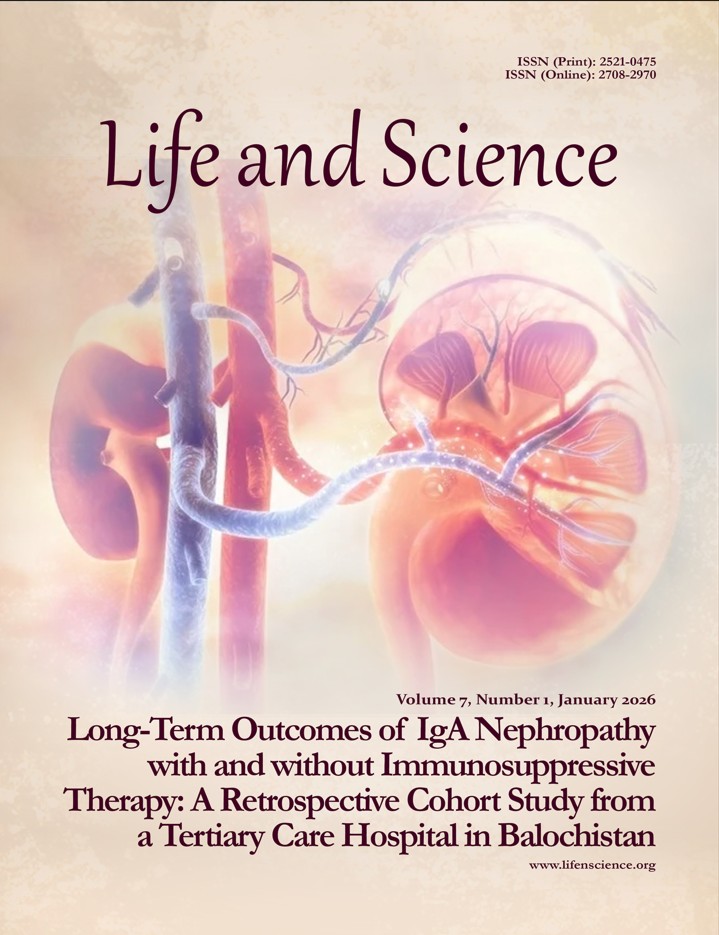
Long-Term Outcomes of IgA Nephropathy with and without Immunosuppressive Therapy: A Retrospective Cohort Study from a Tertiary Care Hospital in Balochistan
DOI:
https://doi.org/10.37185/LnS.1.1.840Keywords:
Glomerulonephritis, IgA Nephropathy, Immunosuppressive Agents, ProteinuriaAbstract
Objective: To evaluate the long-term outcomes and prognostic factors associated with IgA nephropathy (IgAN)
in patients treated with and without immunosuppressive drugs.
Study Design: A retrospective cohort study.
Place and Duration of Study: The study was conducted at the Department of Nephrology, Combined Military Hospital (CMH), Quetta, Pakistan, from May 2023 to May 2024.
Methods: A total of 70 patients diagnosed with biopsy-proven IgAN were included in the study. The patients were divided into two groups: 43 received immunosuppressive drug treatment (IS), and 27 did not (No IS). Patient records were analyzed for clinical, histological, and treatment data. Cox proportional hazards regression was used to assess factors associated with end-stage kidney disease (ESKD), kidney replacement therapy (KRT), and mortality.
Results: The median age of the patients was 32 years, predominantly male (61.4%). Patients in the immunosuppressive drug treatment group had significantly higher systolic blood pressure (P=0.005) and more severe proteinuria (P=0.002). The immunosuppressive drug treatment group showed a greater degree of renal damage, with increased glomerulosclerosis and tubulointerstitial injury, than the non-immunosuppressive drug treatment group. Severe proteinuria, reduced eGFR, and extensive tubulointerstitial damage, as determined by Cox regression analysis, independently predict ESKD and mortality. Patients with extensive tubulointerstitial damage (>50%) and an eGFR below 30 mL/min/1.73 m² were at heightened risk for adverse outcomes. At diagnosis, 35.2% of patients had an eGFR <60 mL/min/1.73 m². Over a median follow-up of 6.3 years, 13 patients (25.4%) progressed to ESRD, and 5 patients (9.8%) died. Complete remission was achieved in 13.7% of patients, partial remission in 39.2%, while 21.5% showed no response to treatment.
Conclusion: Immunosuppressive therapy was associated with more severe renal pathology in IgAN patients. Reduced eGFR, severe proteinuria, and significant histological damage were key predictors of poor renal outcomes.
How to cite this: Khan Z, Altaf A, Fazal N, Kashif N. Long-Term Outcomes of IgA Nephropathy with and without Immunosuppressive Therapy: A Retrospective Cohort Study from a Tertiary Care Hospital in Balochistan. Life and Science. 2026; 7(1): 3-9. doi: http://doi.org/10.37185/LnS.1.1.840
Downloads
Published
Issue
Section
License
Copyright (c) 2026 Zarafshan Khan, Ashfaq Altaf, Nadeem Fazal, Nouman Kashif

This work is licensed under a Creative Commons Attribution-NonCommercial 4.0 International License.